7 Walks with Mark Brown
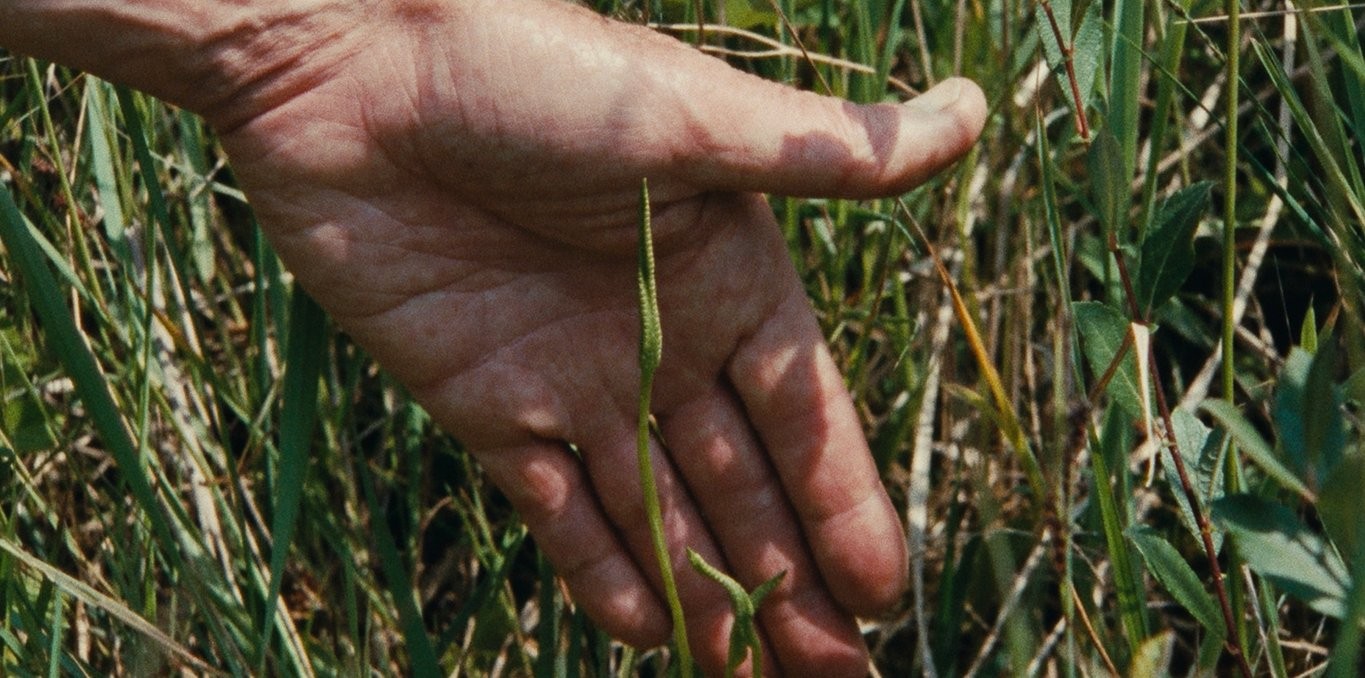
Following the English botanist Mark Brown through the landscapes of the Normandy coast, Pierre Creton and Vincent Barré explore the world of plants and flowers in seven walks. The documentary unfolds in two stages, from the filmed journal to the resulting cinematic herbarium.
| Directors | Pierre Creton, Vincent Barré |
| Actor | Emmanuel Bernier |
| Share on |
The films of Pierre Creton and his faithful companion Vincent Barré possess a kind of admirable magic—let us call it of pure document—that is to say, an overflowing, contagious desire for the (living) world. Here, this desire takes shape through the figure of ethnobotanist Mark Brown, a deeply endearing mediator: erudite, eccentric in the way he names each plant (as if speaking to them?). It also emerges through the entirely dialectical way in which the present film approaches and organizes itself: first, with digital camera or microphone in hand, a journal that forages among a thousand signs of the world, the constant interactions of this joyful group with everything around them, as they travel down the Norman coastline from the Seine to the sea in search of native plants that will serve to recreate an immemorial herbarium...(Re)creation, seven walks—on the seventh day, did they rest?
Then (and it is perhaps a pity to reveal this), a second part unfolds as a rediscovery of the botanical findings along the route we have just seen, meticulously captured throughout the first part by a second duo of filmmakers using their analog machinery—leaving us to wonder whether we, too, would be granted the chance to discover these images. And it is undoubtedly in this way that one touches upon the pure document: through desire, through waiting, alongside the filmmakers themselves, for the revelation of images at the end of the (al)chemical process of the darkroom. What greater desire could there be, for those who have practiced—or still practice—analog photography, than to receive the call from the lab (your images are ready)? And in this waiting, through all the bonds that are woven and that bind us to the world, one might recall one of Robert Bresson’s Notes on the Cinematographer…
Of two deaths and three births.
My film is born first in my head, dies on paper; is resuscitated by the living persons and real objects I use, which are killed on film but, placed in a certain order and projected on a screen, come to life again like flowers in water.
Emmanuel Bernier
Artist, ornithologist, and Head of Acquisitions at Tënk

-
Français
1h44
Language: Français -
English
1h44
Language: English
Subtitles: English
- Année 2024
- Pays France
- Durée 104
- Producteur Andolfi
- Langue French
- Sous-titres English
- Résumé court A serene amble along the coast of Normandy in search of primitive plants endemic to the Pays de Caux region.
- Ordre 4
- TLF_Applismb_CA 1
- Date édito CA 2025-12-26
The films of Pierre Creton and his faithful companion Vincent Barré possess a kind of admirable magic—let us call it of pure document—that is to say, an overflowing, contagious desire for the (living) world. Here, this desire takes shape through the figure of ethnobotanist Mark Brown, a deeply endearing mediator: erudite, eccentric in the way he names each plant (as if speaking to them?). It also emerges through the entirely dialectical way in which the present film approaches and organizes itself: first, with digital camera or microphone in hand, a journal that forages among a thousand signs of the world, the constant interactions of this joyful group with everything around them, as they travel down the Norman coastline from the Seine to the sea in search of native plants that will serve to recreate an immemorial herbarium...(Re)creation, seven walks—on the seventh day, did they rest?
Then (and it is perhaps a pity to reveal this), a second part unfolds as a rediscovery of the botanical findings along the route we have just seen, meticulously captured throughout the first part by a second duo of filmmakers using their analog machinery—leaving us to wonder whether we, too, would be granted the chance to discover these images. And it is undoubtedly in this way that one touches upon the pure document: through desire, through waiting, alongside the filmmakers themselves, for the revelation of images at the end of the (al)chemical process of the darkroom. What greater desire could there be, for those who have practiced—or still practice—analog photography, than to receive the call from the lab (your images are ready)? And in this waiting, through all the bonds that are woven and that bind us to the world, one might recall one of Robert Bresson’s Notes on the Cinematographer…
Of two deaths and three births.
My film is born first in my head, dies on paper; is resuscitated by the living persons and real objects I use, which are killed on film but, placed in a certain order and projected on a screen, come to life again like flowers in water.
Emmanuel Bernier
Artist, ornithologist, and Head of Acquisitions at Tënk
-
Français
Duration: 1h44Language: Français1h44 -
English
Duration: 1h44Language: English
Subtitles: English1h44
- Année 2024
- Pays France
- Durée 104
- Producteur Andolfi
- Langue French
- Sous-titres English
- Résumé court A serene amble along the coast of Normandy in search of primitive plants endemic to the Pays de Caux region.
- Ordre 4
- TLF_Applismb_CA 1
- Date édito CA 2025-12-26