Jean Painlevé, fantaisie pour biologie marine
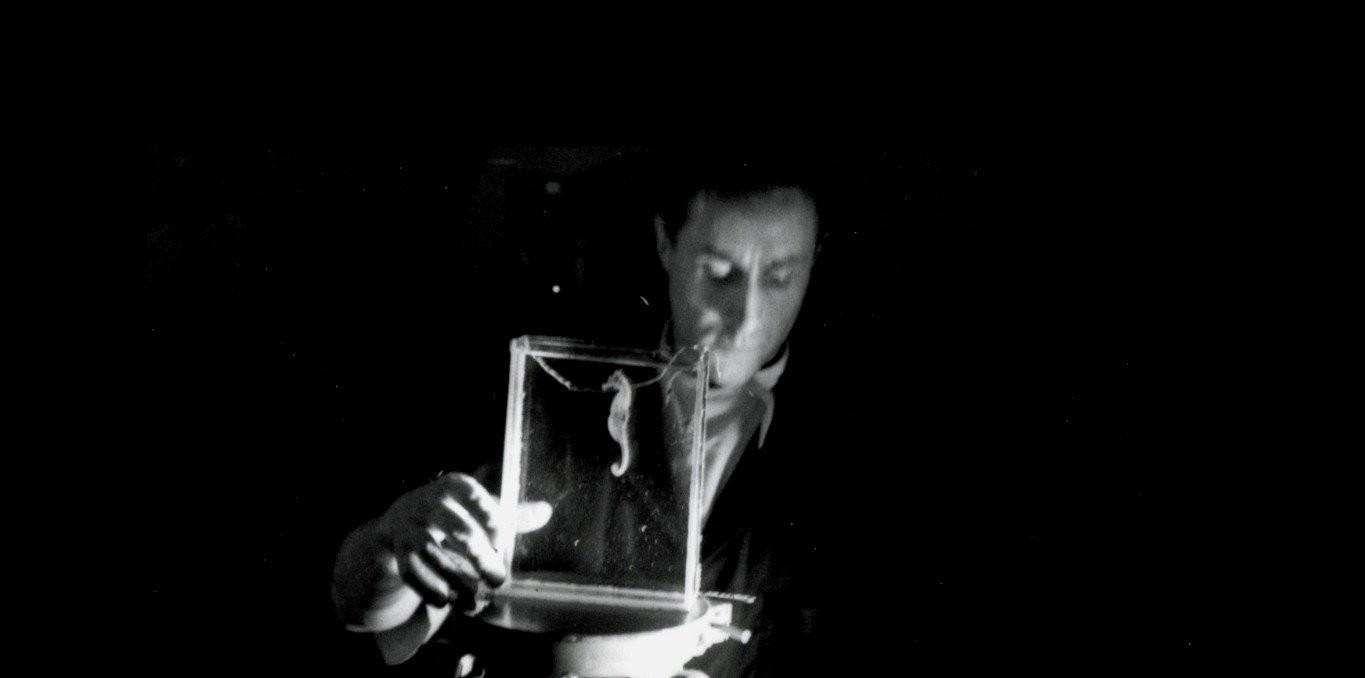
_Jean Painlevé, fantaisie pour biologie marine_ traces the life and work of a man who played an essential role in the history of cinema. This atypical filmmaker, steeped in both scientific research and avant-garde thinking, was close to Jean Vigo, Alexander Calder, Luis Buñuel, and Sergei M. Eisenstein. He was able to create a dialogue between two disciplines: art and science. Thanks to their aesthetic quality, further enriched by the patina of time, the images of Painlevé shown in the documentary have lost none of their magic, their fantasy, or their poetry.
| Director | François Lévy-Kuentz |
| Share on |
The singularity of the work of artist Jean Painlevé and his wife Geneviève Hamon, who has unjustly remained in the shadows, does not stem from the fact that he was the first to establish the genre of the scientific film. In my view, it resides rather in the idea he embodied: that science needs art in order to apprehend and understand worlds—here, in particular, the underwater fauna. At the time, many scientists disparaged his work, judging it to be futile and of little interest.
This discourse, which sets science against art and objectivity against subjectivity, is today beginning to fade in certain circles, in favor of a convergence of perspectives—and that is a good thing. The anthropologist Tim Ingold has tirelessly defended the necessity of a reconciliation between art and science, arguing that the future can only be built collectively, through dialogue and conversation, by making human life itself a conversation.
But perhaps the most enduring trace left by this artist-scientist—aside from the well-known creation of the World Union of Documentary Filmmakers—lies in his crossing of a line in his narrative, which becomes metaphorical and gives form to his antifascist and communist commitments, with the freedom that only an artistic gesture can embody.
Painlevé practiced the kind of sensitive attentiveness required by both art and science.
Sylvie Lapointe
Filmmaker

-
Français
53 mn
Language: Multilang
- Année 2005
- Pays France
- Durée 53
- Producteur Les Documents Cinématographiques
- Langue French
- Résumé court Who was Jean Painlevé? An avant-gardist who masterfully blended art and science with lyrical sensibility in his work.
- Ordre 1
- TLF_Applismb_CA 1
- Date édito CA 2026-01-02
The singularity of the work of artist Jean Painlevé and his wife Geneviève Hamon, who has unjustly remained in the shadows, does not stem from the fact that he was the first to establish the genre of the scientific film. In my view, it resides rather in the idea he embodied: that science needs art in order to apprehend and understand worlds—here, in particular, the underwater fauna. At the time, many scientists disparaged his work, judging it to be futile and of little interest.
This discourse, which sets science against art and objectivity against subjectivity, is today beginning to fade in certain circles, in favor of a convergence of perspectives—and that is a good thing. The anthropologist Tim Ingold has tirelessly defended the necessity of a reconciliation between art and science, arguing that the future can only be built collectively, through dialogue and conversation, by making human life itself a conversation.
But perhaps the most enduring trace left by this artist-scientist—aside from the well-known creation of the World Union of Documentary Filmmakers—lies in his crossing of a line in his narrative, which becomes metaphorical and gives form to his antifascist and communist commitments, with the freedom that only an artistic gesture can embody.
Painlevé practiced the kind of sensitive attentiveness required by both art and science.
Sylvie Lapointe
Filmmaker
-
Français
Duration: 53 minutesLanguage: Multilang53 mn
- Année 2005
- Pays France
- Durée 53
- Producteur Les Documents Cinématographiques
- Langue French
- Résumé court Who was Jean Painlevé? An avant-gardist who masterfully blended art and science with lyrical sensibility in his work.
- Ordre 1
- TLF_Applismb_CA 1
- Date édito CA 2026-01-02