The Trial
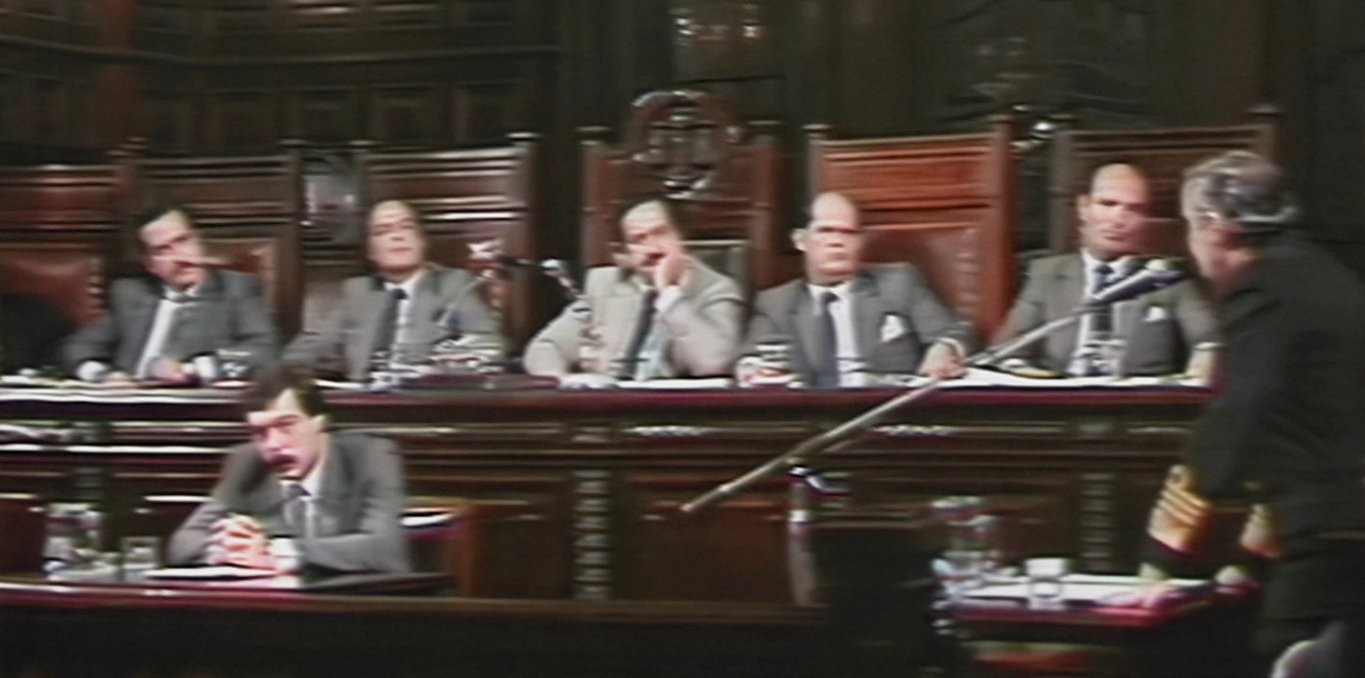
Following the collapse of the Argentinian dictatorship, the new democratically elected government held a judicial trial of nine high-ranking representatives of the military Junta. The accused were prosecuted with crimes that included kidnapping, torture, forced disappearance, and the murder of over 8000 thousand people from 1976-1983. The trial was recorded for broadcast television on over 500 hours of U-matic tape; Ulises de la Orden’s film is crafted entirely from the resulting material. The resulting film stands as a compelling and vital document of the importance of bearing witness and legal process.
| Directors | Ulises de la Orden, Ulises de la Orden |
| Share on |
There are too many images. That much is obvious. This excess leads to saturation, even to disgust. All these images, all these sounds, all these signs trying to make contact with us—but what kind of dialogue are they actually seeking to provoke? A film like El Juicio brings us back to the essence of the document. Perhaps it even brings us back to the fundamentals of testimony. Here, one might almost think we are dealing with surveillance cameras. And yet certain choices are at work; certain constraints shape and color the document.
The camera operator frames the military men as they speak, laugh, and socialize, wholly absorbed in not hearing, in not confronting what is being said. What unfolds here—the words ricocheting off the walls of the courtroom, the detailed accounts of the regime’s crimes, the relentless demonstration of a genocidal system inspired, among other fascistic ideologies, by Nazism, the survivors describing what horror looks like when it takes on human features—all of this, the guilty parties shield themselves from it, draped in a posture of disavowal that nonetheless seems psychically unsustainable.
Several witnesses or relatives of the disappeared use the word “Dantesque” to describe what they witnessed. One may wonder how the human imagination could even wish to venture into such dark places. But to grasp how human beings could participate in, claim, and survive the implementation of such sadism, such a staging of horror, such a taste for destruction—is beyond comprehension. One does not easily recover from having been confronted with it, even through a screen. It is, among other reasons, to understand organized evil from the inside—over-rationalized, internalized, justified—that this film stands out as a document of inestimable value.
This trial is part of a broader process of justice and reparation aimed at acknowledging the wrongs suffered. Through the various testimonies heard in court, a form of memorial reparation is underway, alongside the pursuit of retributive justice. By releasing and receiving the victims’ words, an entire segment of memory is activated, politicized, and re-enacted—something even the leaders of the military junta opposed, advocating instead that “the social wounds of the recent past be covered with a veil of silence” in order to move forward. Yet no process of justice can dispense with the work of memory, so that it may be “never again,” nunca más. And that is the unbearable tragedy of our time: that this nunca más has failed to prevent what is being replayed today, from Israeli prisons to ICE detention centers, and that this trial now feels less like an achievement than a repetition.
Naomie Décarie-Daigneault
Tënk's Artistic Director

-
Français
2h57
Language: Français
Subtitles: Français -
English
2h57
Language: English
Subtitles: English
- Année 2023
- Pays Argentina, Italy, France, Norway
- Durée 177
- Producteur Polo Sur Cine
- Langue French, English, Spanish
- Sous-titres French, English
- Résumé court 1985, Argentina. The trial of the Military Juntas of the last dictatorship (1976-83), accused of crimes against humanity.
- Mention festival Prix Giuseppe Becce · Berlinale 2024
- Date édito CA 2026-02-13
There are too many images. That much is obvious. This excess leads to saturation, even to disgust. All these images, all these sounds, all these signs trying to make contact with us—but what kind of dialogue are they actually seeking to provoke? A film like El Juicio brings us back to the essence of the document. Perhaps it even brings us back to the fundamentals of testimony. Here, one might almost think we are dealing with surveillance cameras. And yet certain choices are at work; certain constraints shape and color the document.
The camera operator frames the military men as they speak, laugh, and socialize, wholly absorbed in not hearing, in not confronting what is being said. What unfolds here—the words ricocheting off the walls of the courtroom, the detailed accounts of the regime’s crimes, the relentless demonstration of a genocidal system inspired, among other fascistic ideologies, by Nazism, the survivors describing what horror looks like when it takes on human features—all of this, the guilty parties shield themselves from it, draped in a posture of disavowal that nonetheless seems psychically unsustainable.
Several witnesses or relatives of the disappeared use the word “Dantesque” to describe what they witnessed. One may wonder how the human imagination could even wish to venture into such dark places. But to grasp how human beings could participate in, claim, and survive the implementation of such sadism, such a staging of horror, such a taste for destruction—is beyond comprehension. One does not easily recover from having been confronted with it, even through a screen. It is, among other reasons, to understand organized evil from the inside—over-rationalized, internalized, justified—that this film stands out as a document of inestimable value.
This trial is part of a broader process of justice and reparation aimed at acknowledging the wrongs suffered. Through the various testimonies heard in court, a form of memorial reparation is underway, alongside the pursuit of retributive justice. By releasing and receiving the victims’ words, an entire segment of memory is activated, politicized, and re-enacted—something even the leaders of the military junta opposed, advocating instead that “the social wounds of the recent past be covered with a veil of silence” in order to move forward. Yet no process of justice can dispense with the work of memory, so that it may be “never again,” nunca más. And that is the unbearable tragedy of our time: that this nunca más has failed to prevent what is being replayed today, from Israeli prisons to ICE detention centers, and that this trial now feels less like an achievement than a repetition.
Naomie Décarie-Daigneault
Tënk's Artistic Director
-
Français
Duration: 2h57Language: Français
Subtitles: Français2h57 -
English
Duration: 2h57Language: English
Subtitles: English2h57
- Année 2023
- Pays Argentina, Italy, France, Norway
- Durée 177
- Producteur Polo Sur Cine
- Langue French, English, Spanish
- Sous-titres French, English
- Résumé court 1985, Argentina. The trial of the Military Juntas of the last dictatorship (1976-83), accused of crimes against humanity.
- Mention festival Prix Giuseppe Becce · Berlinale 2024
- Date édito CA 2026-02-13