First Stripes
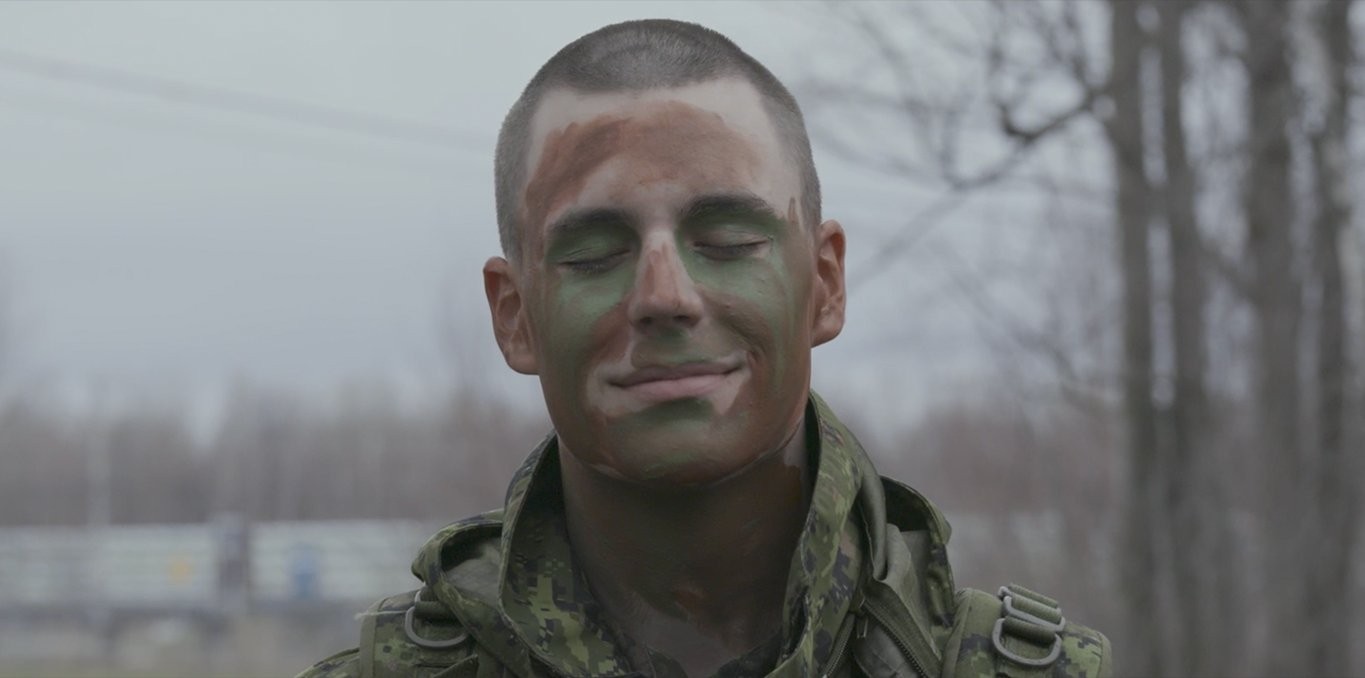
Over the course of a 12-week intensive training program, young adults are gradually transformed into members of the Canadian Armed Forces. For these future soldiers, the group is now more important than the individual, and the country comes before oneself. Without judgment, _First Stripes_ offers an immersion into the singular world of the military through their basic training. A mandatory step for any career in the military, this phase serves as our gateway to exploring from the inside the journey of a diverse cohort as they navigate the demands of learning a new profession with a mix of apprehension and enthusiasm.
| Director | Jean-François Caissy |
| Share on |
Revisiting Caissy’s body of work through the lens of institutional sociology is a fascinating endeavor. The Canadian Armed Forces recruit camp fits perfectly into what sociologist Erving Goffman described as a “total institution.” Such an institution is closed and hierarchical. Its residents have very little contact with the outside world and undergo what Goffman called a “mortification of the self”: they are gradually called upon to shed their individuality in favor of a new, homogeneous, and institutional identity—that of the soldier.¹
An interesting choice, then, to use this setting where individuality is erased as a way of addressing the transition into adulthood. At first glance, this perspective might suggest a cynical reading, in which becoming an adult would coincide with the erasure of the self in favor of a predetermined social role—the individual who conforms to the mold. But Caissy’s work is anything but cynical.
First Stripes reveals instead the limits of this mortification: the individual resists, even if often unconsciously. The documentary suggests that the institution itself seems aware of this, because it is in the tension between the role imposed upon them and the individuality they carry within them that something takes shape. Stripped of their bearings and confronted with the limits of their abilities, these young people seem to mature at breakneck speed. Perhaps that is where the paradox lies: to become soldiers, they must first learn to know themselves as individuals. The army, a remarkable accelerator of individuation?
Jason Todd
Programmer and filmmaker
¹ Erving Goffman, “The Underlife of a Public Institution,” in Asylums: Essays on the Social Situation of Mental Patients and Other Inmates (Anchor Books, 1961)

-

Français
Language: Français -
English
Language: English
- Année 2018
- Pays Quebec
- Durée 107
- Producteur ONF / NFB
- Langue French
- Sous-titres English
- Résumé court Over the course of 12 weeks of intensive training, young adults are gradually transformed into members of the Canadian Armed Forces.
- Ordre 3
- TLF_Applismb_CA 1
- Date édito CA 2026-08-28
Revisiting Caissy’s body of work through the lens of institutional sociology is a fascinating endeavor. The Canadian Armed Forces recruit camp fits perfectly into what sociologist Erving Goffman described as a “total institution.” Such an institution is closed and hierarchical. Its residents have very little contact with the outside world and undergo what Goffman called a “mortification of the self”: they are gradually called upon to shed their individuality in favor of a new, homogeneous, and institutional identity—that of the soldier.¹
An interesting choice, then, to use this setting where individuality is erased as a way of addressing the transition into adulthood. At first glance, this perspective might suggest a cynical reading, in which becoming an adult would coincide with the erasure of the self in favor of a predetermined social role—the individual who conforms to the mold. But Caissy’s work is anything but cynical.
First Stripes reveals instead the limits of this mortification: the individual resists, even if often unconsciously. The documentary suggests that the institution itself seems aware of this, because it is in the tension between the role imposed upon them and the individuality they carry within them that something takes shape. Stripped of their bearings and confronted with the limits of their abilities, these young people seem to mature at breakneck speed. Perhaps that is where the paradox lies: to become soldiers, they must first learn to know themselves as individuals. The army, a remarkable accelerator of individuation?
Jason Todd
Programmer and filmmaker
¹ Erving Goffman, “The Underlife of a Public Institution,” in Asylums: Essays on the Social Situation of Mental Patients and Other Inmates (Anchor Books, 1961)
-
Français
Language: Français -
English
Language: English
- Année 2018
- Pays Quebec
- Durée 107
- Producteur ONF / NFB
- Langue French
- Sous-titres English
- Résumé court Over the course of 12 weeks of intensive training, young adults are gradually transformed into members of the Canadian Armed Forces.
- Ordre 3
- TLF_Applismb_CA 1
- Date édito CA 2026-08-28