Metro
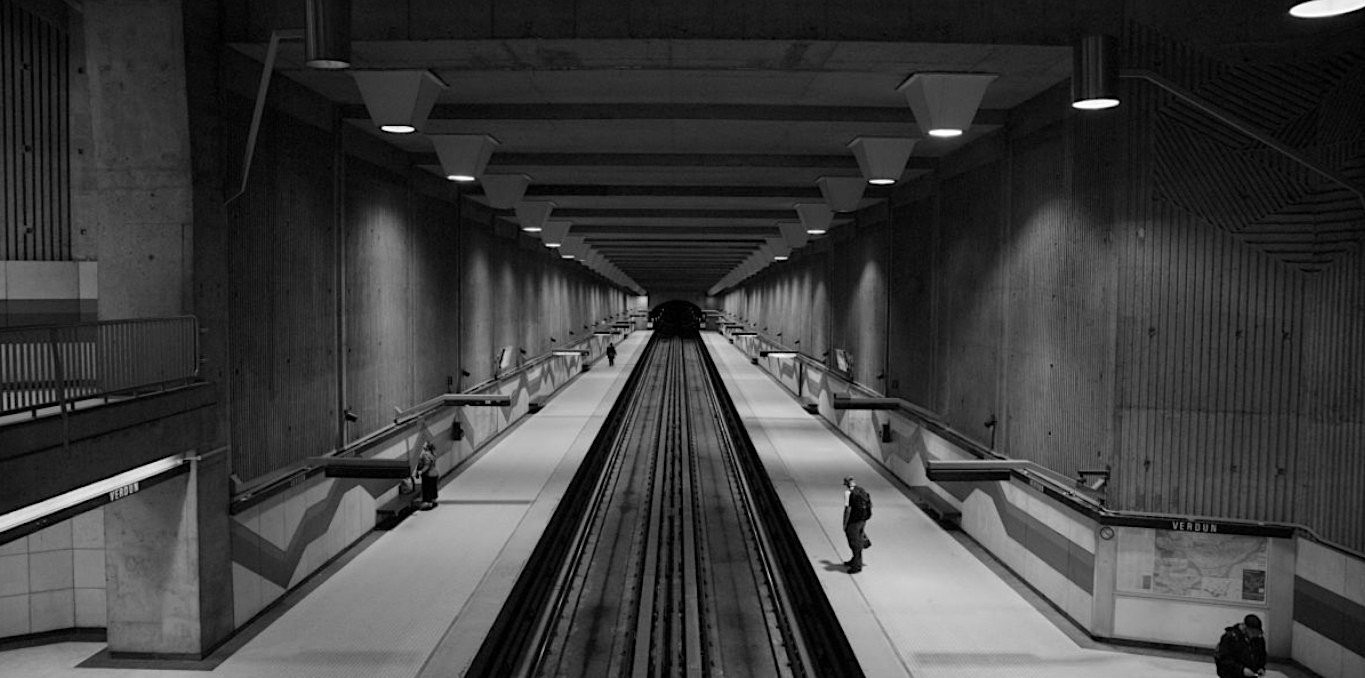
By taking a fresh look at the spaces that make it up and the life that inhabits it, _Metro_ observes the gestures, mechanics and underside of this monumental underground network that weaves the city together and irrigates it on a daily basis. From the roar of the ventilation system to the vast ceilings above, the film reveals a place of rare magnitude, with singular acoustics and a human presence in constant motion. _Metro_ is an invitation to rediscover, in all its surprising dimensions, this intriguing universe and the breath that drives it.
| Director | Nadine Gomez |
| Share on |
Although director Nadine Gomez pays some attention to the people who inhabit and use the Montreal metro, it must be said that she is far more interested in the space itself in this 17-minute short film. Here, people are merely passing through, even if they occasionally remain still in the frame for a brief sequence. The fact that, within the first minute, the filmmaker shows the strange marks left on the walls behind the benches along the platforms—faded, eerily human silhouettes appearing like ghosts of past passengers—says a lot about the place of humans in her vision of the metro, the ultimate passageway through the city. All these people are ephemeral elements of the metro, absorbed in their thoughts, rarely interacting with one another, and largely oblivious to this extraordinary space they traverse daily.
Like many subway systems around the world, Montreal’s is distinctly iconic, with public artworks scattered throughout its network and, above all, the completely different style of each of its stations. Only its infrastructure—ticket kiosks, escalators, the sharply rectangular blue cars—and its signage—the station names in white letters on black bands running along the walls, the emblematic white arrow on a blue circle indicating direction—unite the four lines into a coherent, instantly recognizable whole. One might think that choosing black-and-white cinematography for a film about such a vividly colorful place would be a mistake. Yet it becomes clear that stripping away the multiple layers of bright colors in the environment instead reveals the purity and arrangement of shapes, lines, and contours in each station. From the ceramic circles at Peel station to the massive concrete slabs of the deep Lucien-L’Allier station, from the glass canopy at Place-des-Arts to the endlessly inventive lighting fixtures, the Montreal metro is a true underground art gallery, defined purely by the creativity and grandeur of its architecture. Shall we meet there to rediscover it?
Claire Valade
Critic and programmer

-
Métro
17 mn
Language: Multilang
- Année 2015
- Pays Quebec
- Durée 17
- Producteur Nicolas Dufour-Laperrière
- Langue Without dialogue
- Résumé court A renewed look at the Montreal metro through the gestures, mechanics, and hidden underside of this monumental underground network that weaves the city together and sustains it daily.
- Ordre 3
- TLF_Applismb_CA 1
- Date édito CA 2026-01-09
Although director Nadine Gomez pays some attention to the people who inhabit and use the Montreal metro, it must be said that she is far more interested in the space itself in this 17-minute short film. Here, people are merely passing through, even if they occasionally remain still in the frame for a brief sequence. The fact that, within the first minute, the filmmaker shows the strange marks left on the walls behind the benches along the platforms—faded, eerily human silhouettes appearing like ghosts of past passengers—says a lot about the place of humans in her vision of the metro, the ultimate passageway through the city. All these people are ephemeral elements of the metro, absorbed in their thoughts, rarely interacting with one another, and largely oblivious to this extraordinary space they traverse daily.
Like many subway systems around the world, Montreal’s is distinctly iconic, with public artworks scattered throughout its network and, above all, the completely different style of each of its stations. Only its infrastructure—ticket kiosks, escalators, the sharply rectangular blue cars—and its signage—the station names in white letters on black bands running along the walls, the emblematic white arrow on a blue circle indicating direction—unite the four lines into a coherent, instantly recognizable whole. One might think that choosing black-and-white cinematography for a film about such a vividly colorful place would be a mistake. Yet it becomes clear that stripping away the multiple layers of bright colors in the environment instead reveals the purity and arrangement of shapes, lines, and contours in each station. From the ceramic circles at Peel station to the massive concrete slabs of the deep Lucien-L’Allier station, from the glass canopy at Place-des-Arts to the endlessly inventive lighting fixtures, the Montreal metro is a true underground art gallery, defined purely by the creativity and grandeur of its architecture. Shall we meet there to rediscover it?
Claire Valade
Critic and programmer
-
Métro
Duration: 17 minutesLanguage: Multilang17 mn
- Année 2015
- Pays Quebec
- Durée 17
- Producteur Nicolas Dufour-Laperrière
- Langue Without dialogue
- Résumé court A renewed look at the Montreal metro through the gestures, mechanics, and hidden underside of this monumental underground network that weaves the city together and sustains it daily.
- Ordre 3
- TLF_Applismb_CA 1
- Date édito CA 2026-01-09