The Horse Palace
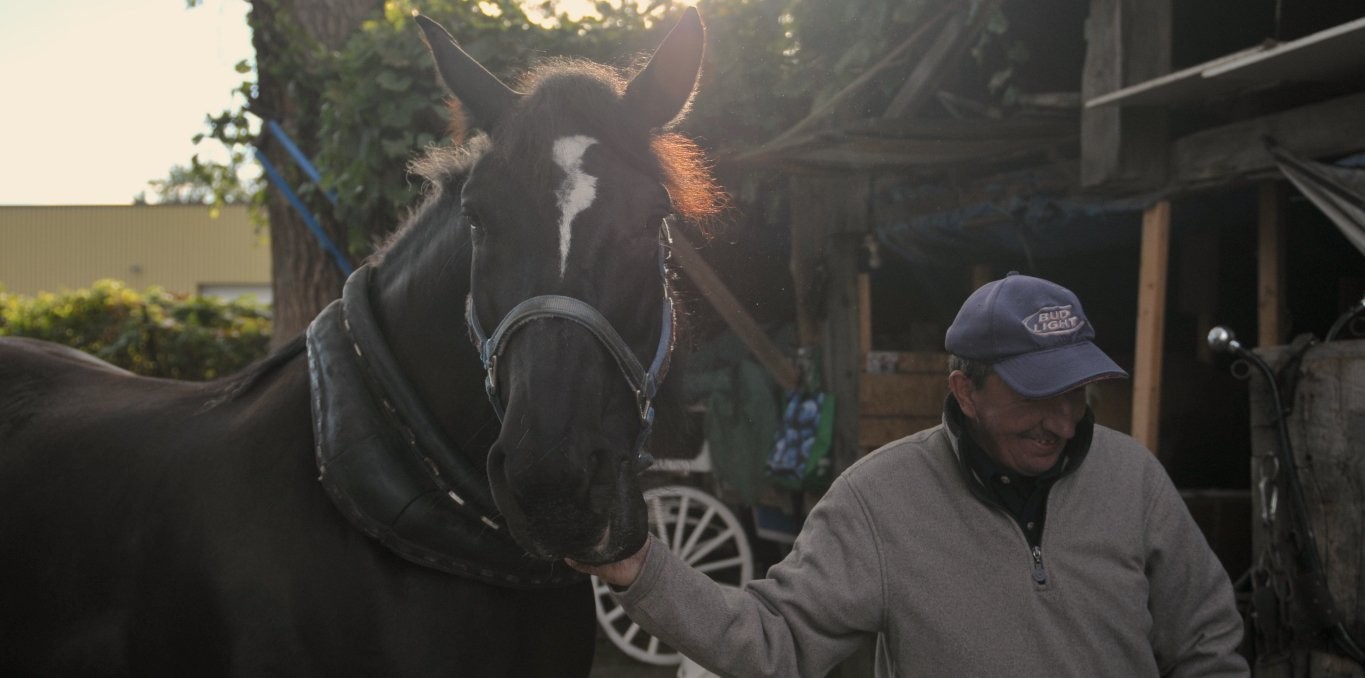
Amid the abandoned factories and crumbling buildings of Griffintown lies Montreal’s oldest stable, the last remnant of a bygone era. In this intriguing, anachronistic enclave, brushing up against modernity, time seems to have stood still. But ever since its aging owner decided to sell the property, the days of the Horse Palace are numbered…
| Directors | Nadine Gomez, Nadine Gomez |
| Share on |
Documentaries often serve this essential function: preserving traces of what a certain culture of progress and profitability tends to erase. With The Horse Palace, Nadine Gomez focuses on a space on the verge of extinction — one of Montreal’s last urban stables, tucked away in the heart of a Griffintown now exposed to real estate speculation.
Built in 1862, the stable was for decades a city hub where horses and drivers provided transport, snow removal, and tourism. Today reduced to a marginal activity, this reality is disappearing under the pressure of a real estate boom that is rapidly reshaping the urban landscape.
Through the dignified, solitary figure of Leo Leonard, owner of the stable for many years, The Horse Palace captures the gradual erasure of a segment of Montreal’s working-class memory. Griffintown, historically shaped by Irish and then French-Canadian communities, was long a melting pot of popular cultures now largely forgotten. Gomez continues a documentary tradition initiated by filmmakers like Sylvain L’Espérance (Les printemps incertains, 1992), filming urban transformations as signs of social fracture.
As the filmmaker’s first feature to explore urban territory, The Horse Palace announces a central concern of her work: understanding how the city transforms, and what these changes reveal about our relationship to memory, popular culture, and the place of marginalized groups in urban space. Through a careful and attentive cinematic approach, she also documents the erosion of a certain Montreal — that of workers, the margins, and the quiet transmission of traditions.
Frédérick Pelletier
Filmmaker and teacher, École des médias, UQAM

-
Français
1h08
Language: Français -
English
1h08
Language: English
- Année 2012
- Pays Quebec
- Durée 68
- Producteur Argus Films
- Langue French, English
- Sous-titres French, English
- Résumé court Leo Leonard, coachman, facing the impending tsunami of condo towers in downtown Montreal. An urban tale about city heritage.
- Ordre 3
- TLF_Applismb_CA 1
- Date édito CA 2026-01-09
Documentaries often serve this essential function: preserving traces of what a certain culture of progress and profitability tends to erase. With The Horse Palace, Nadine Gomez focuses on a space on the verge of extinction — one of Montreal’s last urban stables, tucked away in the heart of a Griffintown now exposed to real estate speculation.
Built in 1862, the stable was for decades a city hub where horses and drivers provided transport, snow removal, and tourism. Today reduced to a marginal activity, this reality is disappearing under the pressure of a real estate boom that is rapidly reshaping the urban landscape.
Through the dignified, solitary figure of Leo Leonard, owner of the stable for many years, The Horse Palace captures the gradual erasure of a segment of Montreal’s working-class memory. Griffintown, historically shaped by Irish and then French-Canadian communities, was long a melting pot of popular cultures now largely forgotten. Gomez continues a documentary tradition initiated by filmmakers like Sylvain L’Espérance (Les printemps incertains, 1992), filming urban transformations as signs of social fracture.
As the filmmaker’s first feature to explore urban territory, The Horse Palace announces a central concern of her work: understanding how the city transforms, and what these changes reveal about our relationship to memory, popular culture, and the place of marginalized groups in urban space. Through a careful and attentive cinematic approach, she also documents the erosion of a certain Montreal — that of workers, the margins, and the quiet transmission of traditions.
Frédérick Pelletier
Filmmaker and teacher, École des médias, UQAM
-
Français
Duration: 1h08Language: Français1h08 -
English
Duration: 1h08Language: English1h08
- Année 2012
- Pays Quebec
- Durée 68
- Producteur Argus Films
- Langue French, English
- Sous-titres French, English
- Résumé court Leo Leonard, coachman, facing the impending tsunami of condo towers in downtown Montreal. An urban tale about city heritage.
- Ordre 3
- TLF_Applismb_CA 1
- Date édito CA 2026-01-09