Slet 1988
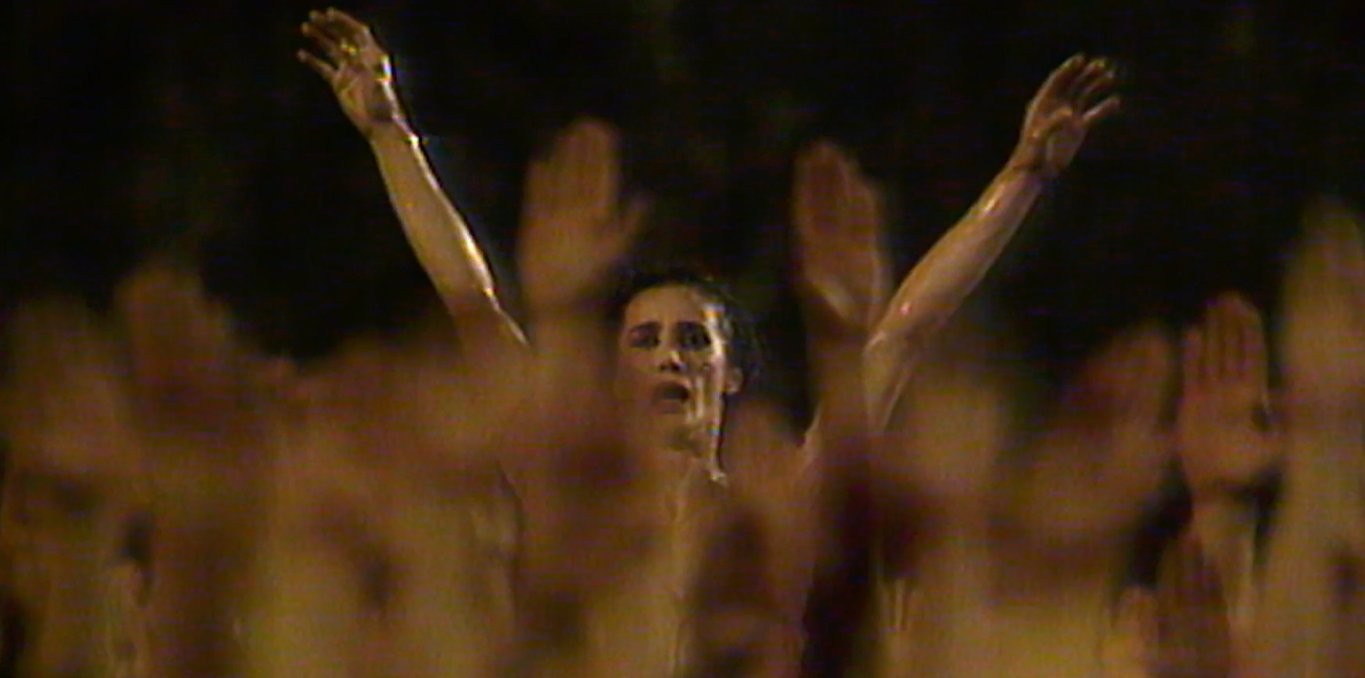
In _Slet 1988_, dancer Sonja Vukićević, aged 74, moves through socialist-modernist spaces; her body is an archive of the last mass performance in Yugoslavia. Her gestures echo past rhythms and present realities, intertwining with a 1988 teenage girl’s diary to reveal the shift from socialist collectivism to rising individualism, while a new national collective body is creeping in and will soon shape the future of the country.
| Directors | Marta Popivoda, Marta Popivoda |
| Share on |
In Slet 1988, Marta Popivoda engages with the body itself as archive. The film becomes a work of performance art in its own right. Popivoda as filmmaker is a choreographer, sculptor, installation artist, assembling archival video footage here, voiceover recordings of a teenager’s diary there, brutalist concrete apartment blocks iconic of SFRY (the Socialist Federal Republic of Yugoslavia) with kids playing in their collective squares as background visuals and audio. Vukićević’s powerful moving body is the throughline: ghostly and spastic as a youth, in her white slip fiery on stage, and strong and grounded as an elder, swimming through the screen, both haunting and quotidian. Here, architecture is a lived-in, embodied art form, as is dance; film as a medium is a site for a performance that is ongoing, the images not only moving but haptic. We are past and present and future all at once.
Popivoda often refers to her work as dealing with the tensions between memory, history, and ideology. In this short, this tension is sensorial, felt. There is something almost foreboding, prophetic about what the voices (both literal and imagistic) on screen knew: that all was not right in their world, that something explosive felt close on the horizon, that a vague darkness was descending. The opening title card tells us that this 1988 Slet would be the last in the SFRY; a viewer in 2026 knows why that is, but we are still left puzzled at its bold aesthetic unconventionality. The Sletovi of the past were necessarily uniform and more aerobic than artistic whereas, what took place in 1988 was arguably not a Slet at all: Vukićević is a unique artist in a modern performance that looks more like Butoh than ballet, surrounded by a sea of dancers waving, yes, in unison, though nothing about it is calisthenic. There are no relay batons to be seen, no cheerful youth representing all regions of the country jogging up to the long-gone leader (May 25th was, after all, celebrated both as Youth Day as well as Tito’s invented birth date). Ravel’s “Bolero“ blares echoes of the Sarajevo Olympics where, just four years earlier, Torvill and Dean’s legendary highest scoring of all time ice dance final, set to the same insistent piece, reverberated from the region across the world.
An epilogue of two sentences of text tell us some of what’s to come, but nonetheless, we are left feeling like our sometimes-teenage narrator who declares, “Slet was incredible. I didn’t understand a thing.” A final text card reads: “A future forever wounded.”
Aurora Prelević
Writer, performance artist, cinephile, programmer

-
Français
22 mn
Language: Français
Subtitles: Français -
English
22 mn
Language: English
Subtitles: English
- Année 2025
- Pays Serbia, France, Germany
- Durée 22
- Producteur Fiskultura Films, Bocalupo Films, Theory at Work
- Langue Serbo-Croatian
- Sous-titres French, English
- Résumé court An elderly dancer performs in modernist Yugoslav spaces as nationalism replaces socialism, paralleled by a teen’s 1988 diary entries.
- TLF_Applismb_CA 1
- Date édito CA 2026-05-08
In Slet 1988, Marta Popivoda engages with the body itself as archive. The film becomes a work of performance art in its own right. Popivoda as filmmaker is a choreographer, sculptor, installation artist, assembling archival video footage here, voiceover recordings of a teenager’s diary there, brutalist concrete apartment blocks iconic of SFRY (the Socialist Federal Republic of Yugoslavia) with kids playing in their collective squares as background visuals and audio. Vukićević’s powerful moving body is the throughline: ghostly and spastic as a youth, in her white slip fiery on stage, and strong and grounded as an elder, swimming through the screen, both haunting and quotidian. Here, architecture is a lived-in, embodied art form, as is dance; film as a medium is a site for a performance that is ongoing, the images not only moving but haptic. We are past and present and future all at once.
Popivoda often refers to her work as dealing with the tensions between memory, history, and ideology. In this short, this tension is sensorial, felt. There is something almost foreboding, prophetic about what the voices (both literal and imagistic) on screen knew: that all was not right in their world, that something explosive felt close on the horizon, that a vague darkness was descending. The opening title card tells us that this 1988 Slet would be the last in the SFRY; a viewer in 2026 knows why that is, but we are still left puzzled at its bold aesthetic unconventionality. The Sletovi of the past were necessarily uniform and more aerobic than artistic whereas, what took place in 1988 was arguably not a Slet at all: Vukićević is a unique artist in a modern performance that looks more like Butoh than ballet, surrounded by a sea of dancers waving, yes, in unison, though nothing about it is calisthenic. There are no relay batons to be seen, no cheerful youth representing all regions of the country jogging up to the long-gone leader (May 25th was, after all, celebrated both as Youth Day as well as Tito’s invented birth date). Ravel’s “Bolero“ blares echoes of the Sarajevo Olympics where, just four years earlier, Torvill and Dean’s legendary highest scoring of all time ice dance final, set to the same insistent piece, reverberated from the region across the world.
An epilogue of two sentences of text tell us some of what’s to come, but nonetheless, we are left feeling like our sometimes-teenage narrator who declares, “Slet was incredible. I didn’t understand a thing.” A final text card reads: “A future forever wounded.”
Aurora Prelević
Writer, performance artist, cinephile, programmer
-
Français
Duration: 22 minutesLanguage: Français
Subtitles: Français22 mn -
English
Duration: 22 minutesLanguage: English
Subtitles: English22 mn
- Année 2025
- Pays Serbia, France, Germany
- Durée 22
- Producteur Fiskultura Films, Bocalupo Films, Theory at Work
- Langue Serbo-Croatian
- Sous-titres French, English
- Résumé court An elderly dancer performs in modernist Yugoslav spaces as nationalism replaces socialism, paralleled by a teen’s 1988 diary entries.
- TLF_Applismb_CA 1
- Date édito CA 2026-05-08