Volleyball
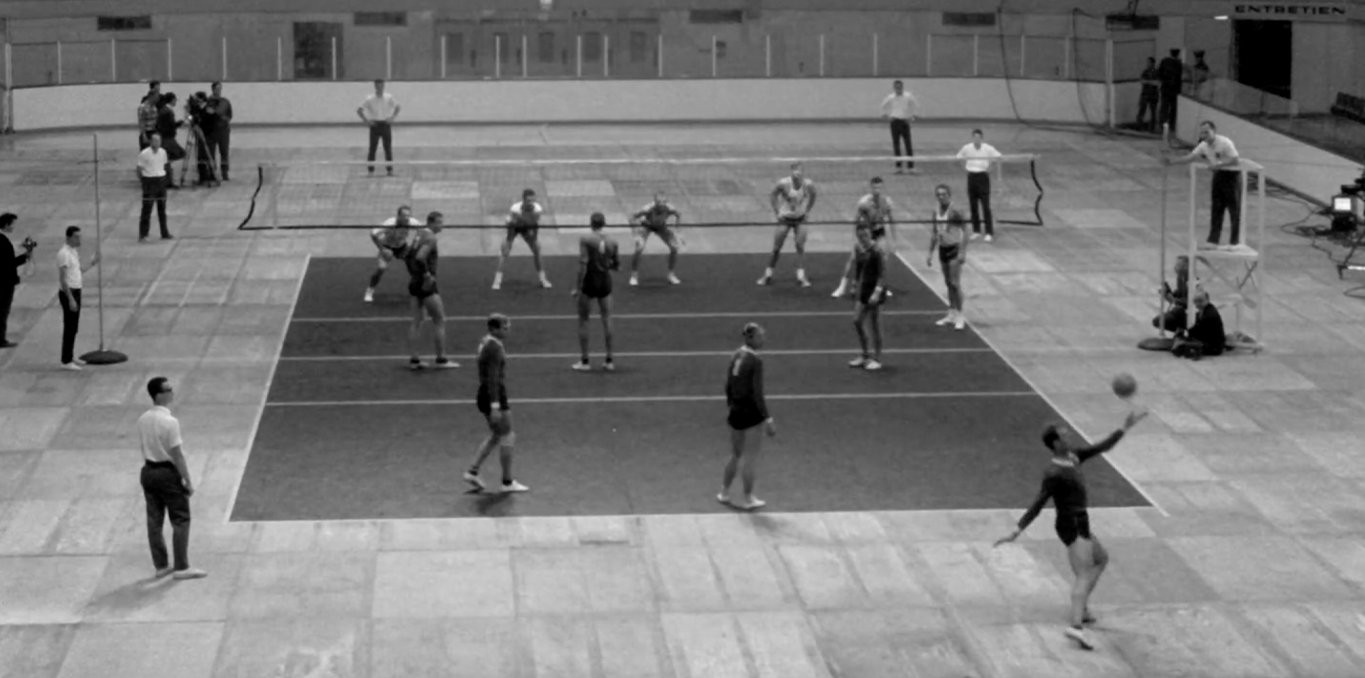
A playful film about volleyball, shot in October 1965 during a match in Montreal between the U.S. and Soviet Olympic teams.
| Director | Denys Arcand |
| Share on |
The Cold War did not turn hot because the confrontations between the two superpowers remained symbolic. Both cinema and sports served as battlegrounds, making this seemingly innocuous film a particularly fascinating object through which to reflect on the rivalry between the communist and capitalist blocs. Viewed through the eyes of a Canadian—a Quebecer, no less—the clash between Soviet and American athletes thus takes on yet another perspective, somewhat removed from the two main blocs.
The sound and visual effects help accentuate the militaristic connotations of the attacks and defenses on both sides of the net—a sort of Iron Curtain that clearly separates the camps. Without narration, the film nonetheless makes us witnesses to this war being waged even on the seemingly harmless arena of a volleyball court. But the perspective is not quite so dichotomous. The mere fact that the event takes place on relatively neutral ground—with the matches held in Montreal—indirectly calls into question Canadian and Quebecois allegiance to the capitalist bloc. Indeed, Canada was seeking its place in the international order: at the federal level, Pearson sought to position the country as a middle power committed to peace. At the provincial level, Quebec, in the midst of the Quiet Revolution, was searching for its path toward modernity. Thus, the alliance with its southern neighbours had its limits, and the USSR did not inspire only rejection.
It should also be noted that the period of détente (1963–1975) was a time when sports played a role in easing tensions, , becoming a space for fraternal encounters between athletes representing opposing systems. In this sense, Arcand also turns his camera toward the moments of camaraderie between athletes. From a sublimation of war, sport becomes a space for mutual understanding — across the curtain… or the net!
Mathieu Boivin-Chouinard
Teacher and historian

-
Français
10 mn
Language: Français -
English
10 mn
Language: English
- Année 1966
- Pays Quebec
- Durée 10
- Producteur ONF / NFB
- Langue Without dialogue
- Résumé court A playful film about volleyball, shot in October 1965 during a match in Montreal between the U.S. and Soviet Olympic teams.
- Ordre 4
- TLF_Applismb_CA 1
- Date édito CA 2026-07-17
The Cold War did not turn hot because the confrontations between the two superpowers remained symbolic. Both cinema and sports served as battlegrounds, making this seemingly innocuous film a particularly fascinating object through which to reflect on the rivalry between the communist and capitalist blocs. Viewed through the eyes of a Canadian—a Quebecer, no less—the clash between Soviet and American athletes thus takes on yet another perspective, somewhat removed from the two main blocs.
The sound and visual effects help accentuate the militaristic connotations of the attacks and defenses on both sides of the net—a sort of Iron Curtain that clearly separates the camps. Without narration, the film nonetheless makes us witnesses to this war being waged even on the seemingly harmless arena of a volleyball court. But the perspective is not quite so dichotomous. The mere fact that the event takes place on relatively neutral ground—with the matches held in Montreal—indirectly calls into question Canadian and Quebecois allegiance to the capitalist bloc. Indeed, Canada was seeking its place in the international order: at the federal level, Pearson sought to position the country as a middle power committed to peace. At the provincial level, Quebec, in the midst of the Quiet Revolution, was searching for its path toward modernity. Thus, the alliance with its southern neighbours had its limits, and the USSR did not inspire only rejection.
It should also be noted that the period of détente (1963–1975) was a time when sports played a role in easing tensions, , becoming a space for fraternal encounters between athletes representing opposing systems. In this sense, Arcand also turns his camera toward the moments of camaraderie between athletes. From a sublimation of war, sport becomes a space for mutual understanding — across the curtain… or the net!
Mathieu Boivin-Chouinard
Teacher and historian
-
Français
Duration: 10 minutesLanguage: Français10 mn -
English
Duration: 10 minutesLanguage: English10 mn
- Année 1966
- Pays Quebec
- Durée 10
- Producteur ONF / NFB
- Langue Without dialogue
- Résumé court A playful film about volleyball, shot in October 1965 during a match in Montreal between the U.S. and Soviet Olympic teams.
- Ordre 4
- TLF_Applismb_CA 1
- Date édito CA 2026-07-17