Direct Action
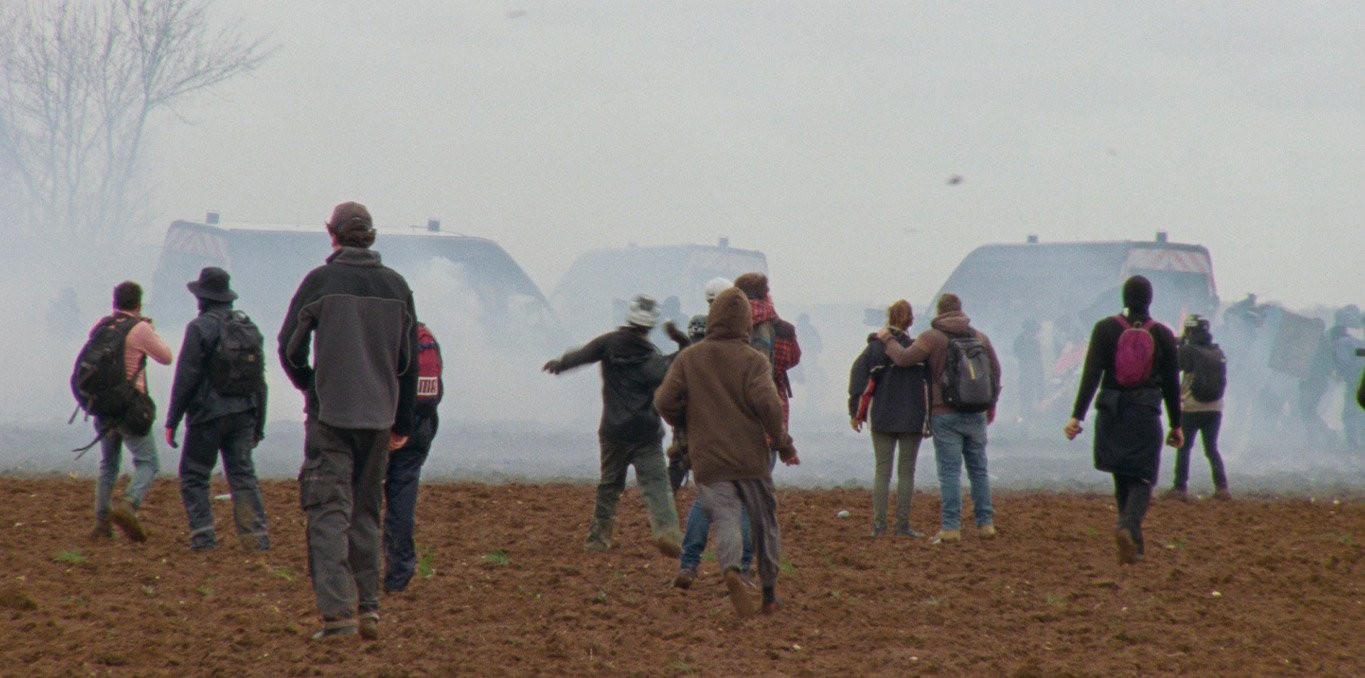
In January 2018, the construction of an airport in rural Notre-Dame-des-Landes was officially canceled, putting an end to years of resistance led by one of the most important activist communities in France. From 2022 to 2023, filmmakers Guillaume Cailleau and Ben Russell immersed themselves in the ZAD (zone-to-defend) to create a portrait of collective life in the years after this unprecedented success. The resulting work documents the transformation of a local struggle into a new ecological protest movement – culminating with the Battle of Sainte-Soline in March 2023, where an act of collective direct action against water privatization was again met by the brutality of State violence.
| Directors | Ben Russell, Guillaume Cailleau |
| Share on |
"Never forget, the shot seems to say, that the blocks of space-time presented in this film have an outside that you will never see. Its thirty-five long takes will present only partial glimpses, held with careful intention but avowedly partial nevertheless. Looking at something always means not looking somewhere else." In the text Observing Otherwise for the three and a half hour film Direct Action, Erika Balsom names the film’s central ethic: a structural commitment to partiality. Shot on 16mm in thirty-five extended takes over one hundred days spent on the ZAD (Zone à défendre) at Notre-Dame-des-Landes between 2022 and 2023, Ben Russell and Guillaume Cailleau’s film moves beyond the documentary impulse toward explanation or overt political framing. Instead, it offers durational encounters with a living collective whose politics are embedded in rhythms of labor, care, waiting, and confrontation. The film’s decision to withhold articulated political language opens an expansive space for intimacy, attention, and thought to unfold, positioning partiality not as a lack but as a structural and ethical commitment.
This commitment is materially and conceptually extended through the book Direct Action gracefully edited by Russell’s partner, Leslie Auguste. The publication does not function as an explanatory supplement, but as a parallel site of encounter, featuring interviews with members of the ZAD that consensually extend the narratives and presences glimpsed in the film. Where cinema necessarily withholds multiplicity, the book creates another register in which voices can speak in their own terms. Even its graphic design reflects this ethic: the custom typeface, composed from the handwriting of the film’s participants, inscribes the project with a collective human imprint. Across film and book, the work acknowledges the limits of any single medium to contain the multitudes of lived reality, proposing instead a distributed authorship across image, text, voice, and material form.
Russell and Cailleau’s approach to production further situates Direct Action within an ethics of relation rather than extraction. In an interview with Antoine Thirion, Russell reflects: “I was living in Marseille, the pandemic was happening and it wasn’t possible for me to travel outside of France. I’ve had a long-standing enthusiasm for collectives and the idea of utopia writ large, for thinking about portraits of spaces that are also portraits of people, and so the ZAD felt like it could be a subject for the film.” Cailleau reframes the title beyond spectacle or confrontation: “Direct action is not just a confrontation with the police, it’s about taking your destiny in your own hands.” Their insistence on consent with their participants, the use of a heavy 16mm camera resistant to rapid capture, and the film’s durational structure collectively refuse immediacy and appropriation. Their process is its own protest. What emerges is not a singular narrative of resistance, but a porous field of co-presence and co-creation, where political life unfolds through shared lives, labor, and the everyday gestures through which people attempt to improve the world we all inhabit.
Sofia Bohdanowicz
Filmmaker

-
Français
3h32
Language: Français
Subtitles: Français -
English
3h32
Language: English
Subtitles: English
- Année 2024
- Pays Germany, France
- Durée 212
- Producteur CASKFILMS, VOLTE Film
- Langue French, English, Arab
- Sous-titres French, English
- Résumé court A hypnotic and politically charged portrait exploring direct action against oppression through the life of an activist community in France.
- Mention festival Meilleur film (section Encounters) et Mention spéciale pour le meilleur documentaire · Berlinale 2024
- TLF_Applismb_CA 1
- Date édito CA 2026-02-13
"Never forget, the shot seems to say, that the blocks of space-time presented in this film have an outside that you will never see. Its thirty-five long takes will present only partial glimpses, held with careful intention but avowedly partial nevertheless. Looking at something always means not looking somewhere else." In the text Observing Otherwise for the three and a half hour film Direct Action, Erika Balsom names the film’s central ethic: a structural commitment to partiality. Shot on 16mm in thirty-five extended takes over one hundred days spent on the ZAD (Zone à défendre) at Notre-Dame-des-Landes between 2022 and 2023, Ben Russell and Guillaume Cailleau’s film moves beyond the documentary impulse toward explanation or overt political framing. Instead, it offers durational encounters with a living collective whose politics are embedded in rhythms of labor, care, waiting, and confrontation. The film’s decision to withhold articulated political language opens an expansive space for intimacy, attention, and thought to unfold, positioning partiality not as a lack but as a structural and ethical commitment.
This commitment is materially and conceptually extended through the book Direct Action gracefully edited by Russell’s partner, Leslie Auguste. The publication does not function as an explanatory supplement, but as a parallel site of encounter, featuring interviews with members of the ZAD that consensually extend the narratives and presences glimpsed in the film. Where cinema necessarily withholds multiplicity, the book creates another register in which voices can speak in their own terms. Even its graphic design reflects this ethic: the custom typeface, composed from the handwriting of the film’s participants, inscribes the project with a collective human imprint. Across film and book, the work acknowledges the limits of any single medium to contain the multitudes of lived reality, proposing instead a distributed authorship across image, text, voice, and material form.
Russell and Cailleau’s approach to production further situates Direct Action within an ethics of relation rather than extraction. In an interview with Antoine Thirion, Russell reflects: “I was living in Marseille, the pandemic was happening and it wasn’t possible for me to travel outside of France. I’ve had a long-standing enthusiasm for collectives and the idea of utopia writ large, for thinking about portraits of spaces that are also portraits of people, and so the ZAD felt like it could be a subject for the film.” Cailleau reframes the title beyond spectacle or confrontation: “Direct action is not just a confrontation with the police, it’s about taking your destiny in your own hands.” Their insistence on consent with their participants, the use of a heavy 16mm camera resistant to rapid capture, and the film’s durational structure collectively refuse immediacy and appropriation. Their process is its own protest. What emerges is not a singular narrative of resistance, but a porous field of co-presence and co-creation, where political life unfolds through shared lives, labor, and the everyday gestures through which people attempt to improve the world we all inhabit.
Sofia Bohdanowicz
Filmmaker
-
Français
Duration: 3h32Language: Français
Subtitles: Français3h32 -
English
Duration: 3h32Language: English
Subtitles: English3h32
- Année 2024
- Pays Germany, France
- Durée 212
- Producteur CASKFILMS, VOLTE Film
- Langue French, English, Arab
- Sous-titres French, English
- Résumé court A hypnotic and politically charged portrait exploring direct action against oppression through the life of an activist community in France.
- Mention festival Meilleur film (section Encounters) et Mention spéciale pour le meilleur documentaire · Berlinale 2024
- TLF_Applismb_CA 1
- Date édito CA 2026-02-13