Ibuka, Justice
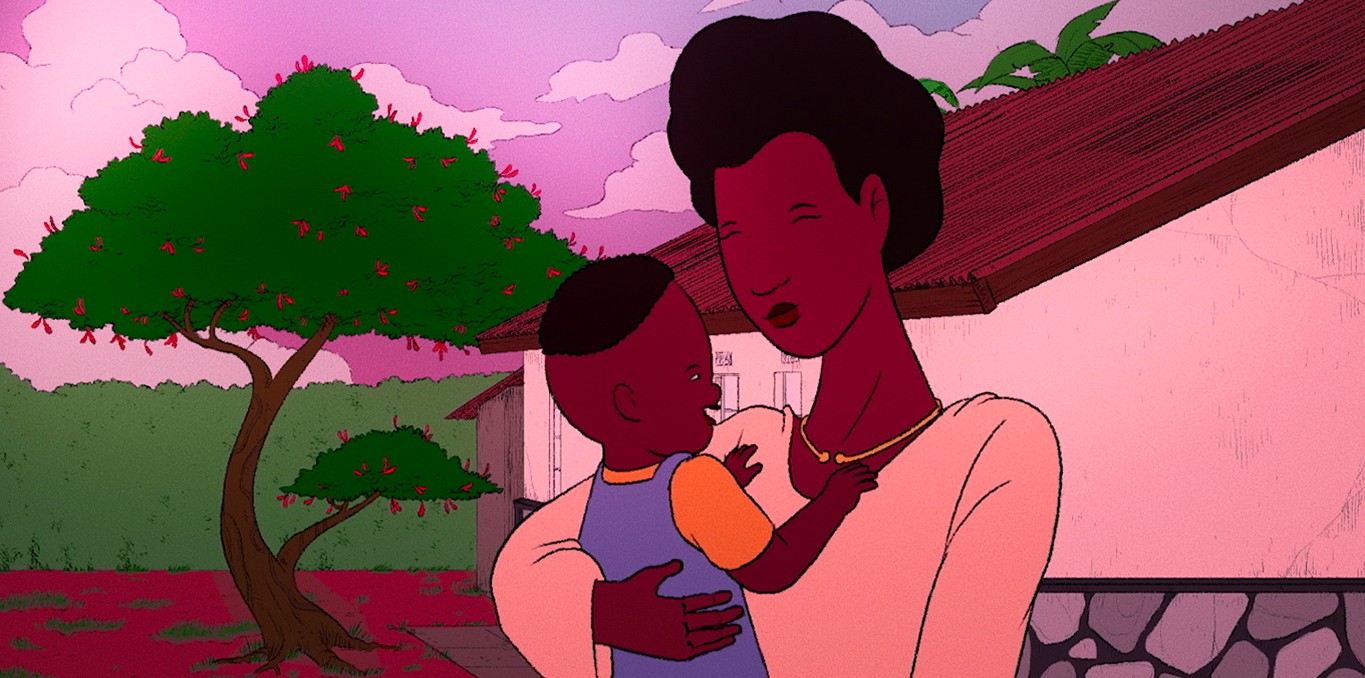
April 6, 1994. A day like any other has turned into an apocalypse for the Rwandan people. In Kigali, Valentine and Jean-Claude, a new couple of young parents, face the threat of a mass hecatomb over their entire country. With the help of several people, they will multiply their attempts to escape from their region with their baby. _Ibuka, Justice_ is an animated, poetic rendering of the crucial moments in this odyssey, narrated by Jean-Claude and Valentine and imagined by Justice, their now grown-up child.
| Director | Justice Rutikara |
| Share on |
First come the slightly faded photographs of a family in the early 1990s: fragments of memories, landscapes, the arrival of a newborn child… Then animation takes over, breathing life once more into these frozen images of the past. A fragile life, for we are in 1994, on the eve of the genocide against the Tutsis in Rwanda. Some thirty years later, Justice Rutikara retraces his parents’ journey on screen through their detailed voice-over testimony. For the newborn in those photographs was him.
Through animation, the filmmaker succeeds in evoking an unspeakable horror with great restraint, bringing vividness to the work of remembrance and reconstructing the experience of those terrible hours and days in an almost methodical way. The clarity of the drawings, the subtlety of the ellipses, and the effectiveness of the visual metaphors serve the story with remarkable precision: through the movements, the hiding places, the moments of terror as well as solidarity, and the flashes of humanity amid dehumanization. The aim is to get to the heart of things with accuracy, while honoring a family love driven by the instinct to survive. The result is deeply moving in its accuracy.
Apolline Caron-Ottavi
Programmer and writer
Cinémathèque québécoise

-

Français
23 mn
Language: Français -
English
23 mn
Language: English
- Année 2024
- Pays Quebec
- Durée 23
- Producteur Yzanakio
- Langue French, Kinyarwanda
- Sous-titres French, English
- Résumé court An animated and poetic reconstruction of the miraculous journey of a young couple and their baby fleeing Rwanda in 1994.
- Mention festival Prix du public · 23e Sommets du cinéma d'animation
- Ordre 1
- TLF_Applismb_CA 1
- Date édito CA 2026-05-15
First come the slightly faded photographs of a family in the early 1990s: fragments of memories, landscapes, the arrival of a newborn child… Then animation takes over, breathing life once more into these frozen images of the past. A fragile life, for we are in 1994, on the eve of the genocide against the Tutsis in Rwanda. Some thirty years later, Justice Rutikara retraces his parents’ journey on screen through their detailed voice-over testimony. For the newborn in those photographs was him.
Through animation, the filmmaker succeeds in evoking an unspeakable horror with great restraint, bringing vividness to the work of remembrance and reconstructing the experience of those terrible hours and days in an almost methodical way. The clarity of the drawings, the subtlety of the ellipses, and the effectiveness of the visual metaphors serve the story with remarkable precision: through the movements, the hiding places, the moments of terror as well as solidarity, and the flashes of humanity amid dehumanization. The aim is to get to the heart of things with accuracy, while honoring a family love driven by the instinct to survive. The result is deeply moving in its accuracy.
Apolline Caron-Ottavi
Programmer and writer
Cinémathèque québécoise
-
Français
Duration: 23 minutesLanguage: Français23 mn -
English
Duration: 23 minutesLanguage: English23 mn
- Année 2024
- Pays Quebec
- Durée 23
- Producteur Yzanakio
- Langue French, Kinyarwanda
- Sous-titres French, English
- Résumé court An animated and poetic reconstruction of the miraculous journey of a young couple and their baby fleeing Rwanda in 1994.
- Mention festival Prix du public · 23e Sommets du cinéma d'animation
- Ordre 1
- TLF_Applismb_CA 1
- Date édito CA 2026-05-15